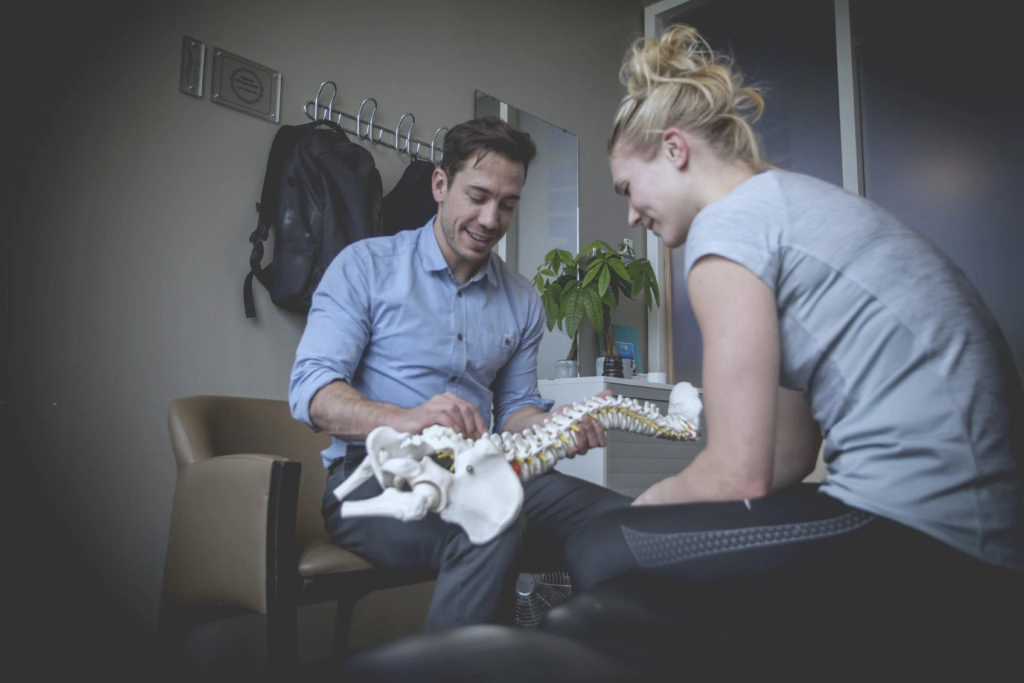
Difference Between a Chiropractor and a Manual Therapist
Chiropractor or manual therapist: both work with their hands, but education, philosophy, techniques and assessments clearly differ — here's how.


Let's clear up the confusion first: chiropractic and manual therapy sound like two names for the same work, and it is a fair question whether your insurer sees a difference. Both deserve an honest answer. The key differences are not in the hands, because both professions are manual; they are in the education, the philosophy, the techniques and the assessments. This article walks you through each one — the background, how each profession thinks about the body, and what each actually does in the consultation — in about three minutes, and how to choose based on your complaint.
Manual therapy vs chiropractic: the short answer
Both professions treat posture and movement complaints (complaints and disorders of the musculoskeletal system) with their hands, and both are reachable without a referral. Both chiropractors and physical therapists use hands-on techniques and contribute to pain management. The difference sits behind the hands: the education, the philosophy, the techniques and the assessments.
The two professions differ most in how they think. A chiropractor thinks in terms of the spine and the nervous system: the body regulates and heals itself through its nerve supply, a restricted joint can interfere with that, and the adjustment restores both movement and the body\u2019s own regulation. A manual therapist thinks in terms of movement and function, in the physiotherapy tradition: the body recovers through movement and exercise, and the therapist\u2019s job is to restore the joint\u2019s function and hand you tools to keep it that way. Those two ways of thinking shape everything downstream — the techniques, the assessments and the treatment plan.
Chiropractic care works with targeted spinal adjustments to the spine and nervous system function. The chiropractic education revolves around the musculoskeletal system: the spine, joints, muscles and the nerves running through them. A chiropractor in the Netherlands holds a DC (Doctor of Chiropractic) or MSc in Chiropractic from an ICCE-accredited programme, typically five to eight years of full-time study abroad, and is registered with the SNRC, the register Dutch insurers recognise. Manual therapy is a specialised branch of physical therapy: in North America, the manual therapist is the physical therapist with extra hands-on training; in the Netherlands, a manual therapist is a physiotherapist with an additional master\u2019s programme in manual therapy — in the NVMT\u2019s words, "a specialised physiotherapist who completed an additional master\u2019s programme in manual therapy after their physiotherapy degree" — registered in the CKR register for manual therapists. Manual therapy thus offers an extra specialisation on top of the physical therapy base. Both professions can help relieve pain, help with recovering from an injury, and support your spinal health; neither prescribes medication.
In one sentence: the two professions look alike as long as you watch the hands, and differ as soon as you look at the education, the philosophy, the techniques and the assessments. They differ in their training, and the choice between a chiropractor or a manual therapist depends on your complaint and your preference. Read on to discover the key differences.
Key differences: chiropractors and Dutch physiotherapists compared
One note before the comparison: there is no chiropractic programme in the Netherlands, so every Dutch chiropractor trained abroad — typically five to eight years at an ICCE-accredited university. The standard behind the title varies by country; our separate article compares the accredited programmes in 20 countries.
| Chiropractor | Manual therapist | |
|---|---|---|
| Philosophy | Spine and nervous system first: the body heals through its nerve supply, so restoring spinal movement supports its own regulation | Movement and function first, in the physiotherapy tradition: the body recovers through movement and exercise, and the patient learns to maintain it |
| Techniques | Targeted spinal adjustments and joint mobilisation to restore movement, improve spinal alignment and reduce nerve pressure | Specific joint examination and treatment with manual techniques, stretching and exercise therapy to restore function |
| Assessment | Posture and movement evaluation, plus diagnostic imaging — bring earlier X-rays, MRI or ultrasound scans | Full functional examination of the joints; imaging interpretation is not part of the standard training |
| Focus | Spine, joints, nervous system | Spine and the joints of the arms and legs, with the emphasis on moving function |
| Education | Full academic degree: DC/MSc, ICCE-accredited, 5\u20138 yrs full-time (Canada: 3-yr bachelor + 4-yr doctorate incl. hospital internship) | Physiotherapy (hbo bachelor\u2019s) plus a master\u2019s programme in manual therapy recognised by KNGF and NVMT |
| Registration | SNRC — insurer-recognised register; ICCE degree + DCF/NCA/CCA membership required | CKR register for manual therapists — via a recognised master\u2019s programme and the BOCK (re)registration requirements |
| Referral | Not needed | Not needed (direct access within the physiotherapy rules) |
| Coverage | 33 of 36 insurers via supplemental, no deductible | Follows the physiotherapy rules: basic insurance for chronic conditions (adults: first 20 themselves), otherwise supplemental |
What happens during a chiropractic adjustment and manual therapy
This is where the difference becomes concrete. A treatment with a chiropractor revolves around targeted adjustments; a treatment with a manual therapist around joint function and exercise. What does a chiropractor actually do, and what does a manual therapist do? Both professions are hands-on, both use joint mobilisation and specific manual therapy techniques, and both aim for pain relief; the difference is emphasis: the chiropractor uses targeted adjustments as the core of the session, the manual therapist examines and treats joint function and builds exercise therapy around it. Neither chiropractors nor manual therapists are massage therapists, and neither replaces the other.
A chiropractic treatment
A chiropractic treatment is built around the adjustment: a quick, precise thrust on a restricted spinal joint, usually in the spine, to restore movement where it is limited, improve spinal motion and reduce pain. Adjustments are sometimes described as correcting spinal misalignments, though the precise clinical description is a restriction in movement. Chiropractic techniques such as the adjustment are delivered by hand or with a small instrument such as an activator or a drop table (Cleveland Clinic). Around it, a treatment typically includes soft tissue therapy — releasing tight muscles, muscle tension and the connective tissue around them — plus joint mobilisation, posture advice and therapeutic exercises to improve movement patterns and move better, so the joint stays stable afterwards. Some patients feel immediate relief after an adjustment. The first visit starts with a full assessment of posture and movement; follow-ups are shorter and focused on the treatment itself. For acute back or neck pain, the usual pattern is two to three treatments per week for two to four weeks, after which the frequency tapers (Medical News Today, 2024).
A treatment with a manual therapist
A manual therapist specialises in diagnosing and treating complaints of the spine and the joints of the arms and legs. The manual therapist focuses on joint function and uses soft tissue techniques and mobilisations that increase the range of motion and better movement, gentle stretching, and sometimes short manipulations. The therapist also works with exercise therapy, almost always: together you build a personalised exercise programme so recovery continues between sessions. An individual session is a fixed item in Dutch healthcare billing, typically around thirty minutes, and your therapist agrees upfront how many sessions are reasonable and what you can do yourself (NZa — physiotherapy service descriptions).
| Chiropractor | Manual therapist | |
|---|---|---|
| Core techniques | Adjustments and joint mobilisation — quick, precise work with the hands or instruments — plus soft-tissue work and exercise advice | Joint mobilisation, stretching, soft-tissue work and exercise therapy; occasionally a manipulation |
| Session | Focused hands-on treatment: the adjustment is the core, with soft-tissue work and exercise advice around it | Examination and treatment of joint function, with an exercise programme you continue at home |
| Assessment | Posture and movement evaluation, plus diagnostic imaging — bring earlier X-rays, MRI or ultrasound scans | Full functional examination of the joints; imaging interpretation is not part of the standard training |
One honest caveat: the two professions are not silos. Chiropractors and manual therapists share a large part of the toolbox — mobilisation, soft-tissue work and exercise advice — and many physio and manual therapists also use manipulative techniques. It comes down to the individual practice: ask whether you would see an experienced chiropractor or manual therapist and what a treatment with them looks like. The same applies to personalized treatment plans: the number and frequency of sessions varies with the practice and with your condition, is determined at your first assessment, and progress is checked at every visit.
In short: the chiropractor is spine-first and adjustment-based; the manual therapist is joint-focused and exercise-based. Neither approach is 'better' — both can relieve complaints in their own way, and the right choice depends on your complaint and your preference.
“Not being familiar with chiropractic care, I found Embody Health through a search. If you are looking for a chiropractor, look no further. I had shoulder and neck problems for a year to a year and a half. Now after 12…”Read the full review
“Not being familiar with chiropractic care, I found Embody Health through a search. If you are looking for a chiropractor, look no further. I had shoulder and neck problems for a year to a year and a half. Now after 12 treatments I feel so much better that my pain is no longer a daily grind. Dr. Stephen Malone is a very skilled chiropractor, friendly, and takes the time for you. This treatment helped me a lot and I would recommend Dr. Stephen to everyone.”

Education and training: physical therapy and chiropractic compared
The difference between chiropractor and manual therapist is not in the hands, but in the education and registration. The training to become a chiropractor in the Netherlands is a full academic degree: a DC or MSc from an ICCE-accredited programme — a full-time university-level education of typically five to eight years abroad, with clinical internships and national board exams. Only graduates of accredited programmes can register with the SNRC, and insurers use that register for coverage decisions. The academic level reaches medical standards at some programmes: Zurich\u2019s chiropractic course covers the full medical curriculum in its first four years (University of Zurich). The standard is not uniform worldwide: the range runs from doctorate-level programmes to private courses without accreditation, which is exactly why the accreditation and the country of training matter. A chiropractor is only as well-trained as the programme behind the title; checking the registration is the decisive step.
The training to become a manual therapist follows a different path: first the hbo bachelor\u2019s in physiotherapy (known as physical therapy in North America), typically three to four years full-time, then a recognised master\u2019s programme in manual therapy. That master\u2019s is a specialisation within physical therapy and offers manual therapy as the deepening after the base degree. Manual therapy and osteopathy are both post-graduate routes after a healthcare degree in the Netherlands; chiropractic is a standalone academic programme. The master\u2019s programme in manual therapy must be recognised by the KNGF and the NVMT, and after graduating the therapist can register in the CKR register for manual therapists, whose (re)registration requirements are set by the BOCK. The title 'manual therapist' is the highest recognised qualification in manual therapy; without the master\u2019s, the title cannot be used.
The contrast is sharpest in the number of study years. A Canadian-trained chiropractor completes at least three years of university bachelor study, then four years of full-time chiropractic training that includes a clinical internship in hospital settings, before national board exams: seven to eight years of post-secondary education in total, ending in a doctorate whose title Dutch law allows as 'dr.' (confirmed by a Dutch court), with training in diagnostic imaging such as radiography interpretation, MRI and ultrasound. The manual therapist spends a further two to three years (part-time) specialising after an hbo base of three to four years. That does not make one profession 'better' at treating you; it does mean the study investment behind the two titles differs substantially, and that the country and accreditation of the chiropractic programme matter. That is why our separate article compares the accredited programmes in 20 countries.
At Embody Health, our chiropractors are all registered (DC, DCF/SNRC). A manual therapist is registered in the CKR register for manual therapists.
What the evidence says about chiropractic for back pain
Evidence is about treatments, not professions. For musculoskeletal conditions such as chronic pain in the back and neck, the evidence for spinal manipulation (the chiropractor\u2019s core technique) is the most extensively researched of all manual therapies: Cochrane reviews conclude that manipulation/mobilisation is effective for chronic low back pain and for neck pain. Manipulative therapy is not owned by any one profession: physical therapists and chiropractors share it, and physicians can qualify in manual medicine, a credential held by tens of thousands of doctors in Germany (Deutsches \u00c4rzteblatt); orthopaedic surgeons use manipulation, for example under anaesthesia for a frozen shoulder (PubMed). Physiotherapists have used spinal manipulation techniques since the start of physiotherapy practice (Physiopedia). For a chiropractor, spinal manipulation is the profession: thousands of hours of recognised full-time study and daily practice. For a manual therapist, joint mobilisation is the specialisation within a physical therapy framework that further relies mainly on exercise therapy, and the evidence for exercising and mobilising in back and neck pain is well established too. Understanding these differences helps you weigh the treatment methods in your choice; both approaches can be effective.
Coverage: chiropractic care and manual therapy
Coverage does draw a distinction here, and it is more nuanced than 'one is in basic insurance, the other is not'. Manual therapy follows the physiotherapy rules: from basic insurance, physiotherapy and manual therapy are covered for chronic conditions on the statutory list. For adults aged 18 and over, the first 20 treatments per condition are paid by you, and the covered treatments count toward your deductible; for children under 18, the coverage is more complete. For most back, neck and joint complaints (which are not on the list) the rule is: no basic coverage, but coverage through supplemental insurance, depending on your policy and the number of sessions it covers (Zorgwijzer, 2026). Chiropractic care is never part of basic insurance: 33 of 36 insurers cover chiropractic through a supplemental package, without a deductible, often with a yearly budget for alternative therapies. Both professions are available as primary care without a GP referral, so the practical question is: does your condition fall under a chronic condition on the list, and what does your own policy cover? Our insurance page shows what each insurer covers.
Which treatment fits your complaint: pain management or rehabilitation?
Why choose manual therapy vs chiropractic? Whether you choose chiropractic or manual therapy depends on your complaint and your preference. These four questions help.
- Back, neck or joint complaints with radiation? The chiropractor specialises in this: they treat both the spot where the pain sits and the cause in posture and movement, without a referral.
- Looking for an approach with exercise and improved joint function? The manual therapist may fit — ask about experience with your specific complaint.
- Is coverage decisive? First check whether your condition falls under a chronic condition on the list (then manual therapy can come from basic insurance); if not, both run through supplemental. Compare your policy on our insurance page.
- Not sure? A first consult is without obligation — ask both professions how they would approach your complaint.
Signs that need attention today
Most posture and movement complaints are harmless and well treatable — including the complaints you may worry about, such as pain after a bike ride or a slight loss of strength. These are everyday presentations, exactly what we see every week. A small group of signs is different and needs attention today:
At Embody Health, every first visit starts with a full examination, because posture and movement complaints like yours are what we assess daily. Most complaints of posture and movement are harmless and well treatable. A small group of signs calls for direct attention:
- Sudden or worsening weakness in an arm or leg
- Loss of feeling around the saddle area or problems urinating or with bowel control
- Fever with pain, unexplained weight loss, or sharp pain that wakes you at night and is not relieved by painkillers
- New double vision, trouble speaking, or problems swallowing
These deserve attention the same day. Contact us — we have 24/7 telephone availability; our front desk alerts the chiropractor right away if it looks urgent. Not sure? Your GP is happy to help you think it through.
No referral needed. Your first visit at Embody Health costs €39 and takes about an hour: intake, examination and an honest recommendation — also if chiropractic is not the right choice for you. Book your appointment through the calendar or WhatsApp.
Next time you search, get an answer this clear again — add Embody to your preferred sources.
Frequently Asked Questions
What’s the difference between a chiropractor and a manual therapist?
The difference between a manual therapist and a chiropractor is not in the hands (both work manually), but in the education, the philosophy, the techniques and the assessments. A chiropractor holds a full academic degree (DC/MSc) from an ICCE-accredited programme and is registered with the SNRC. A manual therapist is a physiotherapist who completed a master’s programme in manual therapy after their physiotherapy degree and is registered in the CKR register for manual therapists.
Manual therapist vs chiropractor: which is better?
There is no 'better' profession; it depends on your complaint and your preference. The chiropractor specialises in targeted adjustments to the spine and the nervous system; the manual therapist in examining and treating joints, usually combined with exercise therapy. The decision questions in this article help you apply that to your complaint.
Is a manual therapist a physiotherapist?
Yes. A manual therapist is a specialised physiotherapist who completed a master’s programme in manual therapy after the hbo physiotherapy degree. The programme must be recognised by the KNGF and the NVMT to qualify for the CKR register for manual therapists.
Is manual therapy covered by health insurance?
Manual therapy follows the physiotherapy rules. From basic insurance, physiotherapy and manual therapy are covered for chronic conditions on the statutory list; adults pay the first 20 treatments per condition themselves, and the deductible applies. For most complaints, coverage runs through supplemental insurance, depending on your policy. Chiropractic is always covered through supplemental insurance and does not count toward your deductible. Check your policy on our insurance page.
Can I see both a chiropractor and a manual therapist?
Yes, the two approaches can complement each other: the manual therapist focuses on joint function and exercise, the chiropractor on targeted adjustments. Tell both practitioners what the other is doing, so the treatments are coordinated.
When should I see a GP instead?
With sudden or progressive loss of strength in an arm or leg, numbness around the saddle area or problems urinating or with bowel control, pain with fever, unexplained weight loss or sharp pain that wakes you at night and is not relieved by painkillers, or new double vision, difficulty speaking or trouble swallowing. See the 'Signs that need attention today' box above.
Sources
- NVMT — Manual therapy register — definition: a manual therapist is a specialised physiotherapist with an additional master\u2019s programme; CKR register
- KNGF/NVMT — Master\u2019s requirement dossier — the master\u2019s programme must be recognised by KNGF and NVMT
- NZa — Service description policy for physiotherapy (BR/REG-22106) — individual manual therapy session as a billable service
- Zorgwijzer — Manual therapy coverage — basic insurance comparable to physiotherapy
- Zorgwijzer — Physiotherapy coverage (2026) — chronic list; first 20 treatments for adults; deductible; supplemental for other complaints
- European Council on Chiropractic Education (ECCE) — accreditation of chiropractic programmes in Europe
- Stichting Nationaal Register van Chiropractoren (SNRC) — register with requirements: ICCE-recognised programme and DCF/NCA/CCA membership
- University of Zurich — first four years of the chiropractic programme: the complete medical curriculum
- CMCC (Canada) — admission requirements: min. 3-year bachelor, four years full-time, national board exams
- CMCC Year IV Clinical Internship — clinical internship: radiography interpretation, MRI, ultrasound
- Gerechtshof Arnhem-Leeuwarden, 11-04-2014 (ECLI:NL:GHARL:2014:3048) — ruling: the DC degree may be used as 'dr.' in the Netherlands
- NTVG 2023;167:C5512 — public prosecutor: 'dr.' by chiropractors 'confusing but not punishable'
- Cochrane CD008112 — spinal manipulation for chronic back pain
- Cochrane CD004249 — manipulation/mobilisation for neck pain
- Physiopedia — Spinal manipulation — physiotherapists have used spinal manipulation since the start of physiotherapy practice
- Deutsches \u00c4rzteblatt — Manuelle Medizin credentials — a physician credential held by tens of thousands of doctors
- PubMed — Manipulation under anaesthesia for frozen shoulder — manipulation as an orthopaedic technique
- Cleveland Clinic — Chiropractic Adjustment — adjustments by hand or with instruments, soft-tissue work, exercises and stretching
- Medical News Today (2024) — chiropractic visit frequency — acute back pain: 2\u20133 sessions per week for 2\u20134 weeks, then less frequent
- Embody Health — insurance page — coverage per insurer; 33 of 36 cover chiropractic through supplemental
- Embody Health — chiropractic and the title 'dr.' — accredited programmes in 20 countries
Next time you search, get an answer this clear again — add Embody to your preferred sources.