Difference Between a Chiropractor and an Osteopath
Chiropractor or osteopath: same hands, two different worlds. The difference is education, registration and approach, backed by 20+ sources.
Let's get the elephant out of the room: you're probably wondering whether one of these is the 'real medical' profession and the other the alternative, and whether your insurance pays for whichever you pick. Both fair questions, and the honest answers are more interesting than the stereotype. The difference between a chiropractor and an osteopath is not in the hands (both are manual therapists), but in the education, the registration, and the approach. This article shows you how to check each one yourself, in about three minutes, and how to choose based on your complaint rather than the marketing.
The short answer
Both professions work with their hands, and both can help with posture and movement complaints. The difference is not in the technique — it's in what sits behind the hands.
A chiropractor in the Netherlands holds a DC (Doctor of Chiropractic) or MSc in Chiropractic from an ICCE/ECCE-accredited programme — a full-time university-level degree that meets an independent European quality standard — and is registered with the SNRC, the register Dutch insurers recognise for coverage. The training focuses on the musculoskeletal system: the muscles, joints, bones and the nerves running through the spine, the parts of your body that hurt when they move wrong. An osteopath looks at how your whole body works together rather than only the spot that hurts, and is trained on top of a healthcare degree — in the Netherlands, physiotherapy is the most common route — with registration, where it exists, through the NOF or NRO register. Both can help, neither prescribes medication, and both aim for pain relief and injury recovery.
In one sentence: the two professions are not interchangeable — the difference is in the training, and the next section shows you why that matters.
Chiropractors and Dutch osteopaths compared
A caveat before you compare: chiropractic education does not exist in the Netherlands, so any Dutch chiropractor studied abroad — five to eight years full-time at an accredited university. How the training behind the title differs per country is explained in our separate article.
| Chiropractor | Osteopath | |
|---|---|---|
| Approach | Specific spinal manipulation and chiropractic adjustments to reduce pain and improve movement | Gentle repetitive mobilisation, soft tissue techniques and stretching — a whole-body approach: the body as one interconnected system |
| Focus | Spine, joints, nervous system | Every part of the body, including circulation and organs |
| Education | Full academic degree: DC/MSc, ICCE-accredited, 5–8 yrs full-time (Canada: 3-yr bachelor + 4-yr doctorate incl. hospital internship — 7–8 yrs total) | Post-graduate: recognised ~5-yr part-time training after an hbo/wo healthcare base (often physiotherapy) |
| Registration | SNRC — insurer-recognised register; ICCE degree + DCF/NCA/CCA membership required | NOF or NRO — voluntary registers; 'osteopath' is not a title protected by law |
| Referral | Not needed | Not needed |
| Coverage | 33 of 36 insurers via supplemental, no deductible | Nearly all insurers via supplemental — no deductible, often the same yearly budget as chiropractic |
What happens during a treatment?
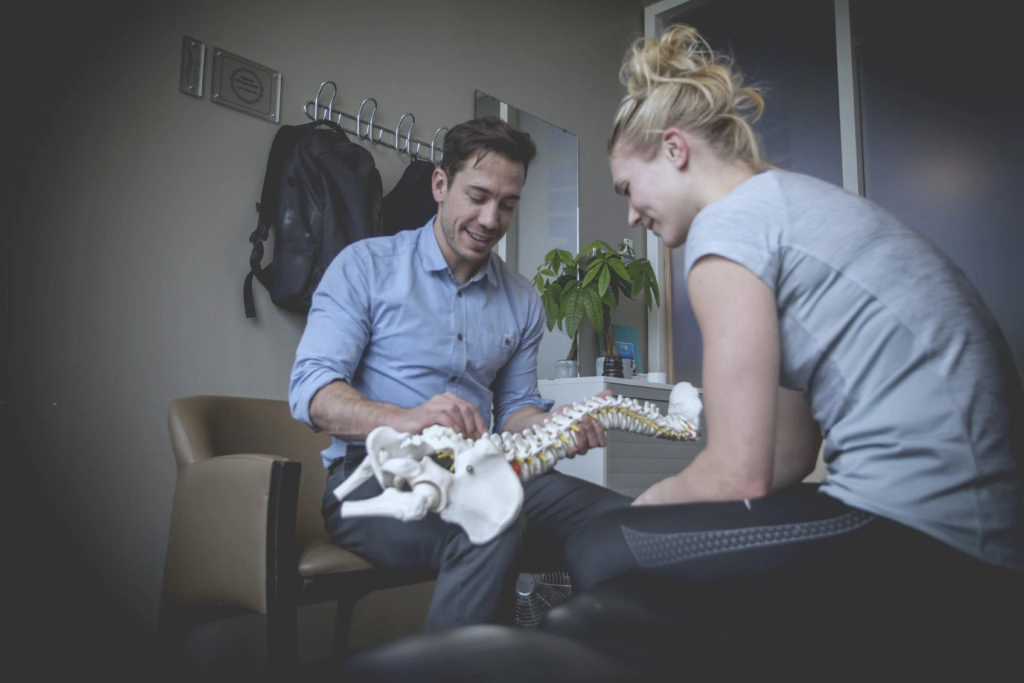
This is where the difference becomes concrete. Both professions are hands-on and share the same family of techniques — the difference is emphasis: a chiropractor treats the spine and joints with targeted adjustments as the core of the session, an osteopath works across the whole body with softer techniques as the core. Here is what each actually does with their hands.
A chiropractic treatment
A chiropractic treatment is built around the adjustment: a quick, precise thrust on a joint (usually in the spine) to restore movement where it is restricted, delivered by hand or with a small instrument such as an activator or a drop table (Cleveland Clinic). Around the adjustment, a treatment typically includes soft-tissue work — releasing tight muscles and the connective tissue around them (fascia) — joint mobilisation, and exercise and stretch advice to keep the joint stable afterwards. Sessions are focused hands-on work: the adjustment and the soft-tissue release come first, with exercise advice to support the result. Follow-up treatments are shorter than the first visit, where the full assessment happens. For acute back or neck pain, the usual pattern is two to three treatments per week for two to four weeks, after which the frequency tapers as the joint stabilises (Medical News Today, 2024).
An osteopathic treatment
An osteopathic treatment starts from the same goal, restoring movement and reducing pain, but works differently. The osteopath uses a broad set of hands-on techniques across the whole body: soft-tissue massage, stretching, gentle joint mobilisation, muscle-energy and myofascial release (techniques that use your own gentle muscle effort and release tension in the connective tissue), and occasionally a manipulation thrust where it fits (ScienceDirect). Sessions typically run around thirty minutes, sometimes longer depending on the practice, and your osteopath agrees a realistic plan with you upfront: the likely number of sessions, what the treatment can achieve, and what you can do yourself between visits (General Osteopathic Council).
| Chiropractor | Osteopath | |
|---|---|---|
| Core techniques | Adjustments and joint mobilisation — quick, precise work with the hands or instruments — plus soft-tissue work and exercise | Soft-tissue massage, stretching, joint mobilisation, muscle-energy and myofascial release, occasionally a thrust |
| Session | Focused hands-on treatment: the adjustment and soft-tissue work are the core, with exercise advice around it | Whole-body techniques plus self-help advice; sessions around 30 minutes, sometimes longer |
| Assessment | Posture and movement evaluation, plus diagnostic imaging — bring earlier X-rays, MRI or ultrasound scans | Hands-on whole-body assessment; no imaging or X-ray review in Dutch training |
One honest caveat: the two professions are not silos. Chiropractors and osteopaths train in a broadly shared toolbox (soft-tissue work, mobilisation and manipulation), and many practitioners cross over: osteopaths occasionally adjust like a chiropractor, and chiropractors regularly use the softer techniques associated with osteopathy. It comes down to the individual practice and the practitioner's own philosophy, so ask what a treatment with them would look like. The same applies to treatment plans: the number and frequency of sessions varies with the practice and with your condition, and is determined at your first assessment, not in advance.
In short: the chiropractor is spine-first and adjustment-based, with focused hands-on treatment; the osteopath is whole-body and softer in pace. Neither approach is 'better' — they are different ways of working with the same tissue, and the right one depends on your complaint and your preference.
“Not being familiar with chiropractic care, I found Embody Health through a search. If you are looking for a chiropractor, look no further. I had shoulder and neck problems for a year to a year and a half. Now after 12…”Read the full review
“Not being familiar with chiropractic care, I found Embody Health through a search. If you are looking for a chiropractor, look no further. I had shoulder and neck problems for a year to a year and a half. Now after 12 treatments I feel so much better that my pain is no longer a daily grind. Dr. Stephen Malone is a very skilled chiropractor, friendly, and takes the time for you. This treatment helped me a lot and I would recommend Dr. Stephen to everyone.”

Education and training
The difference between chiropractic and osteopathy is not in the hands, but in the education and registration. The chiropractic degree in the Netherlands is a full academic programme: a DC or MSc from an ICCE-accredited programme — typically five to eight years of full-time study abroad, with clinical internships and national board exams. Only graduates of accredited programmes can register with the SNRC (accreditation is what makes a programme count), and insurers use that register for coverage decisions. In some programmes the academic level is medical in the strictest sense: at the University of Zurich, the first four years of the chiropractic programme are the complete medical curriculum. One caveat: the standard is not uniform worldwide — the range runs from doctorate-level programmes with full medical curricula to private courses without accreditation, which is exactly why the accreditation and the country of training matter — and why checking the registration is the decisive step. A chiropractor is only as well-trained as the programme behind the title.
A useful distinction: the title Doctor of Chiropractic (DC) is protected — it belongs to graduates of accredited programmes, and its standing was confirmed by a Dutch court. The word 'chiropractor', on its own, is a different matter: in the Netherlands no law reserves it, because no domestic programme exists to give the word an educational standard to uphold. That is a gap in the system, not in the profession — and it is exactly why the register exists. The SNRC admits only graduates of ICCE-accredited programmes, and insurers use the same register for coverage decisions. Ask where the training was completed. As our education article explains, the training behind the title varies by country.
The contrast is worth making explicit. A Canadian-trained chiropractor completes at least three years of university bachelor study, then four years of full-time chiropractic training that includes a 12-month clinical internship in hospital settings, before national board exams: seven to eight years of post-secondary education in total, ending in a doctorate whose title Dutch law allows as 'dr.', including diagnostic imaging: radiography interpretation and reporting, MRI and ultrasound. A Dutch osteopath is typically a physiotherapist (a three-to-four-year hbo bachelor's), who then specialises part-time, in the evenings, in a recognised osteopathy programme of about five years; most osteopaths are physiotherapists themselves, and at most that path ends at master's level. It does not include training in radiology or advanced imaging. Neither statement makes one profession better at treating you, but for you it means one practical thing: a chiropractor has spent years longer in full-time study before treating anyone. The country of training matters, which is why our separate article compares the accredited programmes in 20 countries.
At Embody Health, our chiropractors are registered DC/MSc chiropractors (DCF/SNRC). An osteopath may be registered with the NOF or NRO.
Osteopathic treatment: a whole-body approach
What does 'whole body' actually mean? It means the osteopath does not start with your symptom — they start with how different areas of the body work together, the way a mechanic looks at a car before replacing a part. Chiropractors tend to focus on the spine and nervous system — the wiring from your brain through your spine to every muscle — and use spinal manipulation as the core technique; osteopaths tend to focus on the whole body and overall health, working with the body as an interconnected whole.
Osteopaths use gentle techniques across the entire body, including soft tissue work, stretching, and osteopathic manipulative treatment (OMT, the osteopath's name for hands-on techniques), and are also trained in gentle work around the organs and circulation. The aim is improved blood flow and decreased muscle pain, and osteopathic treatment to reduce pain while supporting the body's own ability to restore function across the spine, joints and the rest of the body — not treating only the symptoms at the site of the pain.
What the evidence says about chiropractic treatment for back pain
Evidence is about interventions, not professions. For people suffering from back pain or neck pain, chiropractic therapy (built on spinal manipulation) is the most extensively studied of the manual therapies: Cochrane reviews conclude manipulation/mobilisation is effective for chronic back pain and for neck pain. Manipulation is not chiropractic's private technique — it is taught across healthcare. Physiotherapists have used spinal manipulation since the beginning of physical therapy practice; physicians can qualify in manual medicine — in Germany, 'Chirotherapie' is a registered physician qualification held by tens of thousands of doctors, and osteopathy has been part of it since 2009; orthopaedic surgeons use manipulation, for example under anaesthesia for a frozen shoulder; and osteopaths perform manipulative treatment as their core hands-on technique. The difference is where the technique sits in the training: for a chiropractor, spinal manipulation is the profession: thousands of hours of full-time, accredited study and daily practice. For other professions it is one technique in a larger toolkit, used alongside their main work. Research specifically on osteopathic treatment is thinner and more mixed. Neither statement means one profession is 'better'; the strength of the evidence differs per condition, and a practitioner's registration tells you the training they received. The care and treatment you receive should always be judged on that evidence and that registration.
How both began tells the same story from the other side. Osteopathy was founded by Andrew Taylor Still in the late nineteenth century as a school of osteopathy rooted in the alternative medicine movement of its time; chiropractic was founded by Daniel David Palmer around the same years. The similarities between chiropractic and osteopathy are no accident: both are hands-on, drug-free systems, and both have spent more than a century trying to prove what manual care can and cannot do, for your health and wellbeing. The difference is not in the history, but in what the two professions built afterwards: full academic degrees with accredited registers on one side, a post-graduate manual specialisation on the other.
Coverage: chiropractic care and osteopathy
Coverage does not tell the two professions apart — both are covered from supplemental insurance. Chiropractic treatment is (partially) covered by 33 of the 36 Dutch insurers, osteopathy by nearly all of them, and often from the same yearly budget for alternative therapies. Neither is part of basic insurance, and neither touches your deductible — the practical question is what your own policy covers. See which insurers cover what on our insurance page.
Will it crack?
Both professions can produce an audible sound in joints — and many people worry about it before seeing a chiropractor or osteopath for the first time. The sound is gas releasing from the joint, not bone grinding, and neither profession requires it: both chiropractic and osteopathic care can be delivered with gentle, low-force techniques. Both treatments are safe when given by a registered practitioner. At Embody Health we regularly treat people who want manual care but are nervous about adjustments — tell your practitioner, and the technique adapts to you, not the other way around.
Which one for your complaint?
The training gap above is not trivia — it decides whether you should see either a chiropractor or an osteopath first for your specific complaint. The similarities between the two are real too: osteopaths and chiropractors are both hands-on, both treat neck and back complaints and complaints of the joints and muscles, and both offer a first consultation without obligation. The right treatment for you depends on the questions below — a chiropractor may be the right choice for radiating pain, an osteopath may be the right choice for a whole-body approach:
- Radiating pain from the back, neck or joints? The chiropractor's training is built around exactly this: the spine and the nerves leaving it, no referral needed.
- Tension and posture across your whole body? The osteopath's approach may fit — ask about experience with your specific complaint.
- Does coverage decide it? Rarely — both are covered from supplemental insurance (chiropractic: 33 of 36 insurers; osteopathy: nearly all). Check your own policy.
- Unsure? A first consultation is free of obligation at both — ask how they would approach your complaint.
Signs that need attention today
Most posture and movement complaints are harmless and treatable — including the ones you might worry about, like pain after a bike accident or a slight loss of strength. Those are everyday presentations, and exactly what a chiropractor assesses daily. A small number of signals are different and deserve same-day attention:
Your chiropractor is a primary-contact practitioner — complaints like yours are what we assess daily, often before anyone else looks at them. We screen for rare medical causes, and most of the time the answer is good news. Most posture and movement complaints are harmless and well treatable. Only a few signals are worth raising yourself:
- Sudden or progressive loss of strength in an arm or leg
- Numbness around the saddle area, or problems urinating or with bowel control
- Pain with fever, unexplained weight loss, or sharp pain that wakes you at night and is not relieved by painkillers
- New double vision, difficulty speaking, or trouble swallowing
These deserve attention the same day. Contact us — we're reachable by phone 24/7; our front desk alerts the chiropractor directly if it seems urgent. Unsure? Your GP is happy to help you think it through.
No referral needed. Your first visit at Embody Health costs €39 and takes about an hour: intake, examination, and an honest recommendation — including if chiropractic isn't the right choice for you. Book via the calendar or WhatsApp.
Next time you search, get an answer this clear again — add Embody to your preferred sources.
Frequently Asked Questions
What’s the difference between a chiropractor and an osteopath?
The difference is not in the hands (both are manual therapists), but in the education, the registration and the approach. A chiropractor holds a full academic degree (DC/MSc) from an ECCE-accredited programme and is registered with the SNRC. An osteopath completes a manual post-graduate training after a healthcare degree (in the Netherlands, physiotherapy is the most common route) and is a member of the NOF or NRO register.
Osteopath vs chiropractor: which is better?
It depends on your complaint and your preference; there is no 'better' profession. The difference between chiropractors and osteopaths is decided by training and registration; what your insurer pays is comparable for both. The decision questions in this article help you apply that. The essential check for both: verify the registration and ask about the training.
Is an osteopath a doctor?
An osteopath in the Netherlands is a manual care specialist: a post-graduate trained practitioner, usually from physiotherapy, and a member of the NOF or NRO register. What they are not is a physician — they cannot prescribe medication or perform surgery. Like 'chiropractor', the title 'osteopath' is not protected by law: the profession's own professional profile states it literally. Checking the registration is the decisive step. One nuance: in the United States, doctors of osteopathic medicine (DO) are licensed physicians who can prescribe medicine — but that is a different profession from the Dutch osteopath.
Is osteopathy covered by health insurance?
Yes, osteopathy is covered from supplemental insurance by nearly all Dutch insurers, in the same way as chiropractic (33 of 36 insurers). Neither is part of basic insurance, and both are often covered from the same yearly budget for alternative therapies. Check your policy on our insurance page.
Can I see both a chiropractor and an osteopath?
Yes, the approaches can complement each other. Whether you see an osteopath or a chiropractor first, tell both practitioners what the other is doing, so the treatments are coordinated.
When should I see a GP instead?
With sudden or progressive loss of strength in an arm or leg, numbness around the saddle area or problems urinating or with bowel control, pain with fever, unexplained weight loss or sharp pain that wakes you at night and is not relieved by painkillers, or new double vision, difficulty speaking or trouble swallowing. See the 'Signs that need attention today' box above.
Sources
- European Council on Chiropractic Education (ECCE) — accredited chiropractic programmes
- SNRC (Netherlands) — registration requirements: ICCE-accredited education + DCF/NCA/CCA membership
- NVO — Professional Profile of the Osteopath (PDF) — 'Osteopaat is geen beschermde titel' (the title is not protected)
- Dutch Osteopathy Federation (NOF) — quality register; recognised osteopathy training (5 years) after an hbo/wo base
- NRO — Nederlands Register voor Osteopathie — register of registered osteopaths; title protection is not regulated by law
- University of Zurich — six-year Chiropractic Medicine programme, first four years = full medical curriculum
- CMCC (Canada) — admission requirements: min. 3 years bachelor (GPA + interview), four years full-time, national board exams
- CMCC Year IV Clinical Internship — clinical internship: radiography interpretation, imaging (MRI, ultrasound), national board exams
- Court of Appeal Arnhem-Leeuwarden, 11-04-2014 (ECLI:NL:GHARL:2014:3048) — the DC degree may be used as 'dr.' in the Netherlands
- NTVG 2023;167:C5512 — Public Prosecution Service: 'dr.' by chiropractors 'confusing but not punishable'
- Cochrane CD008112 — spinal manipulation for chronic low back pain
- Cochrane CD004249 — manipulation/mobilisation for neck pain
- Zorgwijzer — chiropractic coverage; insurers recognise the SNRC register
- Embody Health — insurance page — 33 of 36 insurers cover chiropractic via supplemental
- Physiopedia — Spinal Manipulation — physiotherapists have used spinal manipulation since the beginning of physical therapy practice; manipulation is not exclusive to any one profession
- Deutsches Ärzteblatt — Zusatz-Weiterbildung Manuelle Medizin — 'Manuelle Medizin / Chirotherapie' physician qualification; tens of thousands of registered doctors; osteopathy included since 2009
- PubMed — Manipulation under anaesthesia for frozen shoulders — orthopaedic technique; speeds recovery and improves range of motion
- Cleveland Clinic — Osteopathic Manipulative Treatment (OMT) — hands-on manipulation as the osteopath's core technique
- Zorgwijzer — Osteopathy coverage — nearly all Dutch insurers cover osteopathy from supplemental insurance
- General Osteopathic Council — What to expect at your appointment — sessions typically around 30 minutes; hands-on techniques; realistic treatment plan agreed upfront
- Cleveland Clinic — Chiropractic Adjustment — adjustments by hand or instrument; soft-tissue therapy; exercises and stretches
- ScienceDirect — Osteopathic Techniques — most common OMT techniques: soft tissue, articulatory, counterstrain, myofascial/neuromuscular release, muscle energy, HVLA thrust
- Medical News Today (2024) — How often should a person see a chiropractor? — acute/subacute low back pain: 2–3 treatments per week for 2–4 weeks, then taper
Next time you search, get an answer this clear again — add Embody to your preferred sources.